
Reviewed · WALKING TOURS
Venice Walking Tour: Water, Wood and Stone
Venice, but quieter and built to last. This walking tour connects the city’s survival to water, wood and stone, using Castello and Cannaregio as your backstage pass, and it is guided by Gianmarco who explains with real passion. I especially like how you move from familiar St. Mark’s Square into lived-in calli and campielli, then hit the Venetian Arsenal story that shows why Venice could sail the Mediterranean. One possible drawback: you will be on textured stones, bridges, and easy trails, so bring sneakers and something waterproof just in case.
You also get a calmer feel than the usual rush, because the route is built for observation, not checklists. You start by watching the natural elements around you, then the tour turns those details into a simple, memorable idea: Venice is not just a pretty backdrop, it is engineered for the lagoon.
Over two hours, it stays beginner-friendly and the pacing works. If you are sensitive to crowds, uneven ground, or wet weather, this is a smart way to experience Venice without forcing your way through the loudest streets.
In This Review
- Quick hits
- Finding the guide at P.za San Marco, and starting in the right mindset
- From St. Mark’s Square to quiet calli: seeing how Venice uses materials
- Venetian Arsenal: wood and shipbuilding in 20 minutes of serious context
- Giardini della Biennale: a green pause that still feels like lagoon logic
- San Pietro di Castello (Olivolo): where the lagoon becomes tangible
- The calli and churches wrap-up: your last look at Venice’s everyday side
- Pace, shoes, weather, and the “up to 6 km” reality
- How to think about value when the tour is only 2 hours
- Who this tour is best for
- Should you book Water, Wood and Stone?
- FAQ
- How long is the Venice Walking Tour: Water, Wood and Stone?
- Where does the tour start and end?
- Where exactly do I meet the guide?
- What languages are available for the tour?
- Is the route flat, or will there be lots of climbing?
- How much walking is involved?
- Is it suitable for beginners and families?
- What should I bring with me?
- What clothing is recommended?
- Can I cancel for a full refund, and is reserve-pay-later available?
Quick hits
- Water, wood, stone explained through real corners of Venice, not abstract facts
- Gianmarco’s guidance focused on what you see as you walk
- Venetian Arsenal and its wood expertise, tied to Mediterranean power
- Giardini della Biennale as a calm green pause in the middle of the lagoon city
- San Pietro di Castello, once called Olivolo, for a quieter feel and lagoon lessons
- Hidden calli and inhabited campielli to help you see Venice as something people actually live in
More sestieri crossed bridge by bridge:



Finding the guide at P.za San Marco, and starting in the right mindset
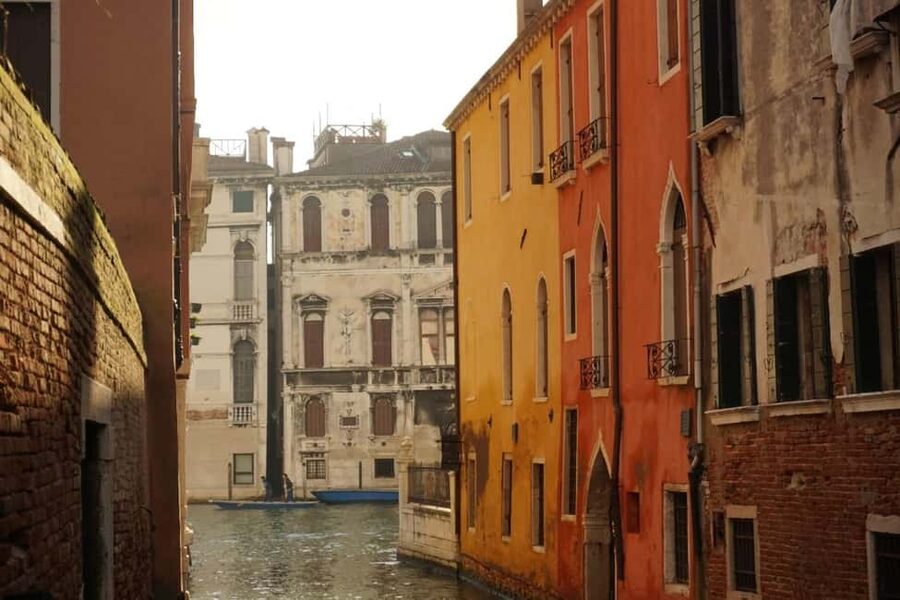
The tour starts at P.za San Marco, 328, and the guide meets you at the foot of the bell tower. You will recognize him by the pink t-shirt with yellow accents. That sounds small, but in Venice it matters. When you start confidently, the whole walk feels smoother, and you spend your energy on details instead of hunting for your group.
Before you even move far, the tour’s approach is what makes it different. You begin with a close look at natural elements around you, then Venice starts to feel like a system. Not a museum. Not a postcard. A place where water dictates materials and materials shape daily life.
The pacing also helps. The whole experience is about 2 hours, with short guided stops and walking segments of roughly 20 minutes at a time. That is long enough to feel like you moved through different parts of the city, but not so long that you are done after St. Mark’s. And since the route is described as flat or with a small positive elevation gain under 100 m, it is not a brutal hike in disguise.
One practical note: even if the walk is easy, you are still in Venice. Expect stones, bridges, and narrow turns. Comfortable shoes are not optional here, they are the difference between relaxed and rushed.
From St. Mark’s Square to quiet calli: seeing how Venice uses materials
The opening stretch is where the tour builds your “why.” Starting from St. Mark’s Square, you move from the obvious grandeur into the in-between spaces where Venice’s logic shows up. You cross ancient stones, and you pass elegant palaces, but the goal is not to admire them from a distance. The goal is to notice how materials respond to water.
That water pressure, humidity, and shifting lagoon environment are the reason you see so much emphasis on construction choices in Venice. The tour frames Venice as a city that rose out of the lagoon, then stayed standing through human ingenuity. It is a story you can feel in the path under your feet and the way buildings meet the street.
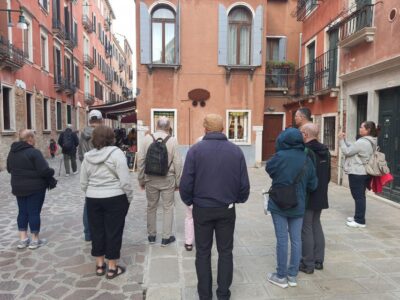
As you leave the busiest edges, you start getting into authentic, quiet calli and inhabited campielli. These are the small streets and open pockets where life continues, where you might see simple routines rather than staged tourist scenes. It is also how the tour reaches Castello and Cannaregio, the historic roots mentioned in the highlights, without turning the whole walk into a fast shopping route.
I like this portion because it teaches you to look. Instead of waiting to be impressed at the next landmark, you learn to notice what matters: surfaces, edges, water lines, and the way Venice fits architecture to constant wet conditions. Even if you do not memorize every detail, your eyes get trained. That is the kind of souvenir that lasts.
Venetian Arsenal: wood and shipbuilding in 20 minutes of serious context
Next up is the Venetian Arsenal, with a guided visit and sightseeing time of about 20 minutes. This is one of the most valuable stops on the tour because it explains the “wood” part of the theme in a practical way. Venice’s power was not just style and symbols. It was logistics, materials, and craft.
The Arsenal is described as the legendary shipyard, and the tour focuses on the mastery of wood that helped create the vessels that once dominated the Mediterranean. That matters, because it connects the lagoon environment to outward expansion. Venice had to solve a transportation problem, and shipbuilding was one solution. Wood was a key tool in that process.
What to watch for during this stop is how the tour ties big history to an everyday reality: Venice’s identity was shaped by what the city could build, what it could maintain, and what it could move. You are not asked to become a naval historian. You are guided to see why this place is central to the city’s story.
A small drawback to consider: Arsenal time is brief, around 20 minutes, so if you want long museum-style wandering, you might leave wanting more. The tour is designed to create understanding, then keep walking. If your goal is maximum time inside one site, this may not be your best match. If your goal is a cohesive theme across Venice, it fits nicely.
The same hours, spent on the water instead:
- Venice: Doge’s Palace Reserved Entry Ticket
★ 4.6 · 42,716 reviews - Venice: Grand Canal Gondola Ride with App Commentary
★ 4.1 · 23,020 reviews - Venice: Grand Canal Gondola Experience with Live Commentary™
★ 4.2 · 16,504 reviews - Boat Trip: Glimpse of Murano, Torcello & Burano Islands
★ 4.3 · 15,699 reviews - Venice: La Fenice Opera House Entry Ticket with Audio Guide
★ 4.6 · 11,742 reviews
Giardini della Biennale: a green pause that still feels like lagoon logic
After the Arsenal, the route brings you to Giardini della Biennale, again with a guided visit and sightseeing plus walking time of about 20 minutes. This is the tour’s “nature” moment, but it is not random park time. The experience frames it as the largest green area in Venice, and the gardens become a quiet break that also reflects the city’s delicate ecosystem.
I like that the tour does not treat greenery as a separate world. You are still learning about balance. Venice thrives because it manages water and environment as a system, and even a garden area fits that bigger picture.
In practical terms, this stop is also a reset. You get a bit more open space in your walking rhythm, which helps if you are getting tired from narrow streets. It is also a chance to slow down and look for the details you might miss elsewhere, like how light moves, how the green space softens the city’s edges, and how calm can exist inside a lagoon city.
One caution: this is still Venice, so if you are visiting in a damp season, you will want that waterproof layer. Even if the gardens are comfortable, the approach paths and nearby areas can feel wet or slick.
San Pietro di Castello (Olivolo): where the lagoon becomes tangible
The tour’s later highlight is San Pietro di Castello, once known as Olivolo. You get a guided visit, sightseeing, and walking time of about 20 minutes here. This is where the tour theme lands emotionally, because the power of water and the balance of the lagoon become more tangible in your surroundings.
San Pietro di Castello is described as peaceful and evocative, and that matches what the theme suggests. After learning about stones, wood, and shipbuilding, you shift to the place where you can feel the lagoon’s influence in the air, the setting, and the mood of the neighborhood.
This stop also works because it is not only about one viewpoint. The route includes crossing bridges and hidden alleyways before and after reaching the island area, so you experience the transition into quieter Venice. That walking sequence matters. You do not just arrive, you get there through the city’s connective tissue.
What makes it a good end-phase stop is that it helps you make sense of Venice as an ongoing living system. The tour’s closing line concept is that the city keeps thriving by living in harmony with natural forces. Standing in a calm zone while your earlier lessons are still fresh makes that idea stick.
If you dislike walking on bridges, pace yourself. Venice’s crossings can feel like a lot when you are tired, even on an easy route. The upside is that each bridge jump is short, and the payoff is the change in perspective.
The calli and churches wrap-up: your last look at Venice’s everyday side
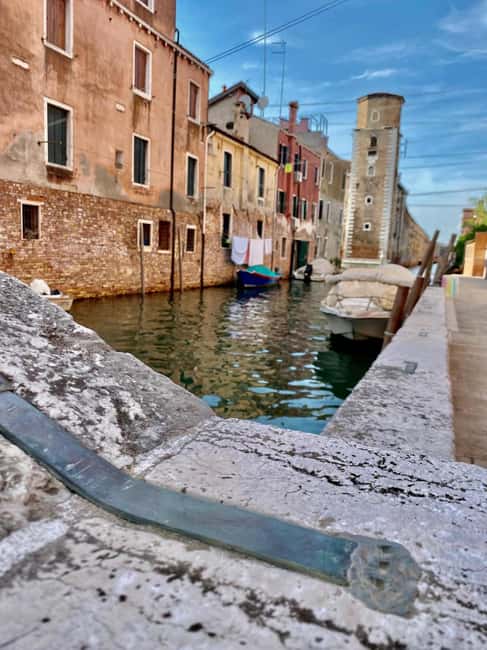
After San Pietro di Castello, you head back toward the start, passing imposing churches and mysterious calli as you return to P.za San Marco, 328. There are also additional walking segments of about 20 minutes built into the route, so you will finish with a full sense of the city’s texture, not just the highlighted nodes.
This wrap-up section is more than a route back. It is where your earlier theme starts to show up in smaller places. You notice how water and stone interact in street-level corners, how buildings hold their shape, and how the city’s survival has become normal daily life.
Because the tour is designed to steer you away from the loudest crowds, this ending often feels like a gentle landing. You start St. Mark’s, you learn a system, and you come back with a calmer understanding of what makes Venice function.
I also appreciate that the tour does not try to cram you into too many stops. The total length is only 2 hours, so the experience stays focused. You leave with a story you can tell, not a blur of names you forget.
Pace, shoes, weather, and the “up to 6 km” reality
The route is described as a flat route or with positive elevation gain of less than 100 m, on forest roads, mule tracks, and easy trails. That description might sound like a hike, but it is also your hint to pack for mixed surfaces. Even if you are not climbing, you are likely to have textured ground and occasional uneven stretches.
Distance is generally listed as no longer than 6 km, which is reasonable for most people in good health. The tour is described as suitable for beginners and families with children, including those with backpacks or trekking strollers. That is a good sign that the route is not extreme.
What I’d recommend based on the equipment notes:
- Bring comfortable shoes you trust on slick stones
- Carry water and a snack
- Dress in layers, and consider a waterproof jacket
- If the season calls for it, add sunglasses, a hat, and sunscreen
A small joke, but it is true: Venice can be pretty, then remind you you are walking on real city surfaces. Good footwear lets you keep your head up and your eyes on the details.
How to think about value when the tour is only 2 hours
You are paying for guided understanding, not just access to three sites. With only 2 hours, the tour has to be efficient, and it is efficient in a smart way. You get a guided look at the Venetian Arsenal, a guided visit and nature pause at Giardini della Biennale, and a guided visit at San Pietro di Castello. That is a strong set of anchors for the theme of water, wood, and stone.
Then you get the less obvious value: learning how to read Venice on foot. You spend time in quieter calli and inhabited campielli, and that helps you see the city beyond its famous edges. If you have already done a basic St. Mark’s and Doge’s Palace loop, this tour gives you something different without asking you to add a second full day.
About the guide factor: the reviews you provided rate this experience 5 out of 5, and one review calls Gianmarco very thorough, passionate, and able to communicate real love for the city. That kind of guide quality matters. In Venice, good explanation turns random streets into meaningful places.
If you want to maximize value, pair this tour with time later for independent wandering. You will recognize the neighborhoods and look for the same water and stone details on your own.
Who this tour is best for
This is a good match if you want:
- A serene side of Venice, away from peak crowds
- A walking experience that focuses on how the city works, not only where to take photos
- A route that suits beginners and can work for families with children
It is also a solid choice if you like thematic tours, because water, wood, and stone gives you a clear framework for every stop. Even if you only catch part of the story, the walking route helps you keep the theme straight.
It may be less ideal if you want a very long visit inside one major site, because the guided segments are about 20 minutes each and the tour stays in motion.
Should you book Water, Wood and Stone?
I’d book this if you want Venice that feels livable and thoughtful, not just famous and crowded. The theme is strong, the route is manageable at 2 hours with up to 6 km of walking, and the stops cover three angles that help you understand why Venice survives in a lagoon environment.
Book it when:
- You want quiet calli and campielli, not only headline sights
- You are curious about the city’s engineering side, especially wood and the Arsenal
- You like guided context that turns stones and water into a story
Skip it if:
- You need fully flat, easy-surface walking only, with no textured stones or bridges
- You prefer long, museum-style time at one location
If you go in with good shoes, a waterproof layer, and the attitude of an observer, you will come away with a Venice that makes more sense than it did this morning.
FAQ
How long is the Venice Walking Tour: Water, Wood and Stone?
The tour lasts 2 hours.
Where does the tour start and end?
It starts at P.za San Marco, 328 and returns back to the same meeting point.
Where exactly do I meet the guide?
The guide is waiting at the foot of the bell tower at P.za San Marco, 328. You can recognize him by a pink t-shirt with yellow accents.
What languages are available for the tour?
The live tour guide speaks Italian and English.
Is the route flat, or will there be lots of climbing?
The route is described as flat or with a positive elevation gain of less than 100 m.
How much walking is involved?
The route is generally described as no longer than 6 km.
Is it suitable for beginners and families?
Yes. It is described as suitable for beginners and families with children, and it can work with backpacks or trekking strollers.
What should I bring with me?
Bring comfortable shoes, snacks, and water, plus comfortable clothes.
What clothing is recommended?
Wear layered clothing and sneakers, and consider a waterproof jacket. Depending on the season, bring sunglasses, a hat, and sunscreen.
Can I cancel for a full refund, and is reserve-pay-later available?
Yes. You can cancel up to 24 hours in advance for a full refund. Also, you can reserve now & pay later.
Lately added around Venice



Walking Tours, compared.
Doge’s Palace and St Mark’s Basilica Walking Tour
Read our review →
San Marco to Rialto Walk & Spritz Like a Local
Read our review →
Private 3 hrs Venice Tour: St Mark’s, Walking tour & Boat tour
Read our review →
Walking Guided Tour of the City Must-See Sites
Read our review →
Private Best of Venice Walking Tour with St Mark’s Basilica
Read our review →
Venice Sightseeing Small Group Walking Tour with a Local Guide
Read our review →Browse the lists this tour appears in