
Reviewed · HIDDEN GEMS & BACKSTREET TOURS
Secret Venice, an unusual walk – Private Walking Tour
Venice has secrets, and this walk shows them. I like that guides such as Federico connect you to Titian and Tintoretto in the churches made for those works, and I also love the cap of eight that leaves real time for questions. The only drawback is that you cover a lot in about two hours, so you should not expect long, sit-down visits inside every stop.
This is a private walking tour (just your group) starting in the Rialto area and ending near Campo San Rocco by the Scuola Grande di San Rocco. If you want Venice highlights with context, plus stories you will not usually hear on a standard route, it is a smart way to spend your late morning.
In This Review
- Key points to know before you go
- Secret Venice walk: Rialto to San Rocco in about two hours
- Titian and Tintoretto: seeing major art in the places it was made for
- Chiesa di San Giacomo di Rialto: Venice’s long timeline begins right where you stand
- Mercati di Rialto: merchants, daily business, and what made the city wealthy
- Rio Terà de le Carampane: learning the story behind the canal name
- Campo San Polo: wells, altanas, and how water shaped Venice
- Campo San Toma and Carnival masks: disguise as culture
- Basilica di Santa Maria Gloriosa dei Frari: a major church, explained in human terms
- Scuola Grande di San Rocco: the walk ends at one of Venice’s most decorated buildings
- How the pace and group size keep this from feeling like a rushed lecture
- Price, value, and who should split the cost
- Best fit: who will enjoy this Secret Venice tour the most
- Should you book this Secret Venice private walking tour?
- FAQ
- How long is the Secret Venice private walking tour?
- What language is the tour offered in?
- Is this tour private?
- Where do you meet and where does the tour end?
- Are there tickets or admissions you need to pay for the stops?
- What happens if weather is poor?
- Is there an extra access fee for some visitors?
Key points to know before you go
- Titian and Tintoretto in their own settings, not just name-dropping in passing
- A small question-friendly group, with guides known for clear, organized explanations
- Rialto markets and merchant life, explained in plain terms
- Rio Terà de le Carampane stories, including the former red light district
- Water in Venice 101, why there are so few wells and what an altana is
- Carnival and masks, with a focus on what the tradition meant and why it mattered
Other walks through the quieter calli:

Secret Venice walk: Rialto to San Rocco in about two hours
This tour is built around a very practical idea: Venice makes sense when you follow a thread. Here, the thread runs from the Rialto side of town, through neighborhood-sized squares and canals, and finishes near one of the city’s most visually impressive school buildings, the Scuola Grande di San Rocco.
Timing is part of the value. Each key moment is short, roughly 15 minutes at the sights, and the guide keeps it moving so you do not waste the best part of your day standing around. You also get the benefit of a private setup, so you can ask the questions that pop into your head as the story shifts from art to water to Carnival.
You start at Campo San Giacomo di Rialto at 11:00 am, and you end at Campo San Rocco, in front of the Scuola Grande di San Rocco. It is a walk that feels like Venice, not a checklist. And at this size, it can work well even if your group has mixed interests, history lovers beside people who just want the story behind the street names.
Titian and Tintoretto: seeing major art in the places it was made for
Venice can be overwhelming. One minute you are admiring a facade, the next you are lost in a maze of calli, and the art you came for starts feeling like random pretty things. What I like about this tour is that it keeps the art anchored to purpose.
You are led to churches where works by Titian and Tintoretto were painted for those locations. That matters because you stop thinking of art as a museum item. You start understanding why a chapel, a church, or a school building wanted a particular artist and a particular subject. The guide’s job is not just to point, it is to explain the why, in a way you can actually use later when you keep exploring on your own.
This also tends to make the churches more watchable, even if you are not a hardcore art specialist. Instead of standing in silence hoping the “right painting” catches your eye, you get a guided lens. Expect clear explanations and a lively tone. People do not book a private tour like this just for dates, they want the story to connect.
Chiesa di San Giacomo di Rialto: Venice’s long timeline begins right where you stand
The first stop is Chiesa di San Giacomo di Rialto, a place that helps you reset your sense of time. You learn about the city’s early background, including the idea of Venice’s deep age of about 1,600 years connected to the area where the church was originally funded.
This is a smart warm-up. You get context before you start moving into busier places like the Rialto market zone. It also helps you understand why Venice built so much around religious and civic identity. Even if you already know Venice is old, the guide turns that into a story about how the city functioned.
Admission is marked as free for this stop, so you can plan to treat the church as a real visit point, not only a photo moment. If you like getting oriented fast, this first segment is designed to do that.
More guides with just your group along:
- Murano & Burano Islands Guided Small-Group Tour by Private Boat
★ 4.5 · 7,580 reviews - Murano & Burano Guided Tour by Private Boat with Glassmaking
★ 4.7 · 5,658 reviews - Private 3 hrs Venice Tour: St Mark’s, Walking tour & Boat tour
★ 4.0 · 3,372 reviews - Venice: Private Crafted Gondola Ride Along Grand Canal
★ 3.8 · 2,854 reviews - Private Best of Venice Walking Tour with St Mark’s Basilica
★ 4.0 · 1,063 reviews
Mercati di Rialto: merchants, daily business, and what made the city wealthy
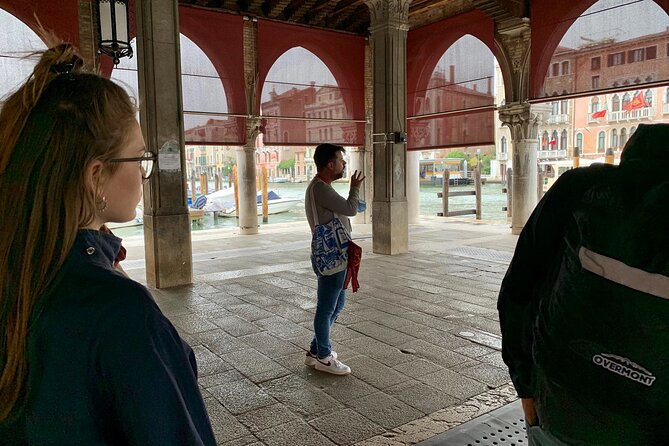
Next comes Mercati di Rialto, where the focus shifts from church-centered Venice to merchant-centered Venice. The guide gives an overview of the market and explains what you need to know about the Venetian merchants who shaped daily life and trade.
This matters because Venice was never just a romantic backdrop. It was a working network of buyers, sellers, ships, and money. When you understand that, you start seeing why certain streets and squares feel the way they do, and why Venice’s wealth left such a visible mark.
A practical tip: arrive mentally ready for movement and noise. Markets have their own rhythm. The guide’s job is to help you read that rhythm, so the market becomes part of the bigger picture rather than just a busy place you pass through.
Admission is marked free here too, so you can spend your time absorbing the explanations rather than figuring out logistics.
Rio Terà de le Carampane: learning the story behind the canal name
Then you reach Rio Terà de le Carampane, and the tour takes a turn into the realm of social history. You hear curiosities and stories about the former red light district, with an emphasis on what that area meant in Venice’s past.
This kind of stop is why this tour is called an unusual walk. You are not only learning art and architecture. You are learning how Venice managed complicated realities, including the idea of where activities happened and how a city shaped rules around them.
What I appreciate is that the tour frames this material as story and context, not shock value. You get the “why” behind the canal name and the neighborhood lore, and that makes it easier to remember once you are back at your hotel and telling someone what you learned.
Campo San Polo: wells, altanas, and how water shaped Venice
At Campo San Polo, the guide tackles a topic that sounds oddly technical until it clicks: why Venice has so few wells, plus an explanation of the altana.
If you are wondering how a city built on water handled everyday water needs, this is your segment. The guide connects the natural environment to how people built their homes and lived. That means “water scarcity” stops being a general trivia line and becomes a practical part of how Venice developed.
Altanas are one of those Venice features that you might notice from street level and never fully understand. Here, you get a clear explanation of what they are and why they mattered. It also helps that you are learning this in a square setting, so the city’s layout is right there to match the story.
Admission is marked free for this stop, so it is easy to take the explanation in without feeling like you must pay extra to make it count.
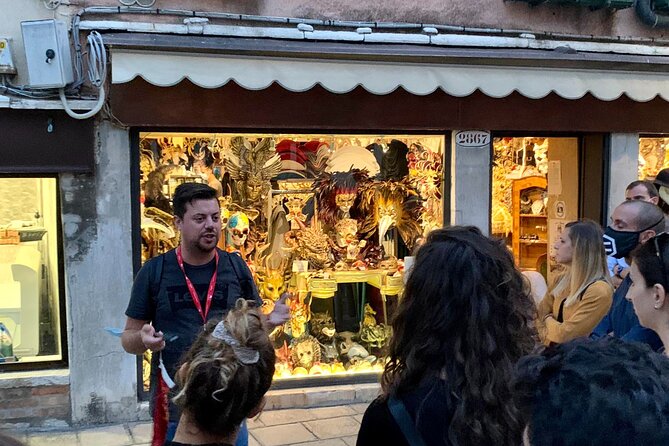
Campo San Toma and Carnival masks: disguise as culture
Next is Campo San Toma, where the tour focuses on Carnival and why masks mattered. This is one of the most fun and human parts of Venice history, because it brings the city’s theater side into the street.
A good guide makes Carnival feel real, not like a distant festival postcard. You learn about the importance of masks and how they connected to identity, behavior, and social life. In practical terms, this also helps you look at Venice differently the next time you see masks in shop windows. You know the tradition behind the decoration.
One added advantage here is the visual angle. You are in a place and time where Carnival symbolism can feel immediate. Even if you are not expecting a workshop, the stop is built to make masks more than a costume, it is built to make them a cultural tool.
Basilica di Santa Maria Gloriosa dei Frari: a major church, explained in human terms
At the Basilica di Santa Maria Gloriosa dei Frari, the tone shifts back to major Venetian landmarks. You get a description of one of the city’s most important churches, with the guide tying the building into the broader story of Venetian art, patronage, and place.
This is where the art thread becomes concrete. Because the tour is already setting you up to notice how artists were connected to specific sites, the Frari visit does not feel like a random church stop. It becomes a continuation of the earlier discussion about Titian and the idea of artworks made for particular settings.
Expect another short segment. In about 15 minutes, the guide gives you a way to look, even if you do not want to spend hours inside. If you are the kind of traveler who likes to return later on your own, this works well because you will know what to notice.
Admission is marked free for this stop, so you should not hesitate to plan on spending at least part of your time inside if the church is open.
Scuola Grande di San Rocco: the walk ends at one of Venice’s most decorated buildings
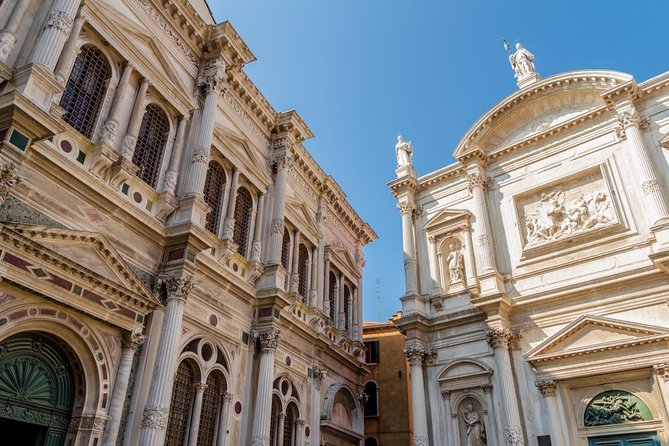
The tour finishes near Scuola Grande di San Rocco, with the guide describing what makes this building so beautifully decorated. You get a sense of why these schools were powerful in Venice, not just fancy places with paint on walls.
This ending is also thematically perfect. You started with early Venice identity, then you moved through merchant life, social stories, water realities, and Carnival culture. Ending at a visually commanding site brings the art and civic pride thread together.
Also, since the tour is designed around Titian and Tintoretto works in the churches or buildings that housed them, this final stop helps you close the loop. You leave with a clearer idea of how Venice used art, not just as decoration, but as a statement of identity.
How the pace and group size keep this from feeling like a rushed lecture
The walking pace is steady but not aggressive. The tour is about 2 hours total, with multiple short segments that keep you from tiring out. Each of the main moments is roughly 15 minutes, which means you get guided context without getting stuck in one place too long.
The cap of eight participants is the secret sauce. In a small group, you can ask follow-up questions without the guide constantly repeating answers. It also tends to keep the atmosphere friendly and flexible. One of the best things you can look for in a guide is the ability to manage attention in a crowd. Here, that part seems to be handled well, with guides working hard to make sure everyone can hear and jump in.
Guides such as Federico and Francisco are praised for being clear and organized, and for mixing information with an intelligent sense of humor. That is not fluff. Humor helps you remember the story, and clear structure makes it easier to connect the dots as you walk.
For this kind of tour, you get the most value if you show up ready to look up as much as you look forward. Venice rewards that.
Price, value, and who should split the cost
The price is listed as $453.01 per group, with the experience sold for groups up to 15. In real life, the value depends on how many people you bring and how much you appreciate guided context.
Here is the math in plain terms. If you have 2 people, you are effectively paying about $226 each for guided services. If you have 4, it is about $113 each. With 6 people, it drops to roughly $75 each. Those are big swings, so the biggest advantage usually comes when you are traveling with a few friends or family members.
What helps justify the cost is that this is not only a walking route. You get guided storytelling focused on major art in specific settings, plus explanation of topics that tourists often skip, like why Venice has so few wells and what altanas are. You also get admission noted as free for each of the listed stops, so you are not stacking up entrance fees on top.
It is also in English and includes a mobile ticket. You do not need to solve the puzzle alone before you even start walking.
Best fit: who will enjoy this Secret Venice tour the most
This tour fits best if you like three things:
- Art, but with a story behind it
- Neighborhood context, not just famous-painting names
- A small group where you can ask questions and get specific answers
It can be a strong choice for families with teens or young adults, because the guide’s tone tends to stay engaging, and the subject matter moves between art, daily life, and Carnival culture. It also works for mixed-interest groups, because you are not stuck in one lane the whole time.
If you are the type who wants to see Venice highlights fast, but you hate feeling like it is all surface level, this route is designed for that sweet spot. You get major places without losing the meaning behind them.
Should you book this Secret Venice private walking tour?
Book it if you want a Venice walk that feels like a conversation with a local, not a checklist. The combination of small-group Q&A, church-linked art context for Titian and Tintoretto, and the story topics like the former red light district, wells, altanas, and Carnival masks make it a memorable use of your time.
Skip it, or at least think twice, if you prefer long independent museum-style visits. This tour is built to move through many meaningful stops in about two hours. You will get great context, but you may still want to come back on your own if you want slow browsing.
One last practical note: it requires good weather. If you book it, plan a backup day in your schedule so you are not stuck if conditions are poor.
FAQ
How long is the Secret Venice private walking tour?
It lasts about 2 hours.
What language is the tour offered in?
The tour is offered in English.
Is this tour private?
Yes. Only your group participates.
Where do you meet and where does the tour end?
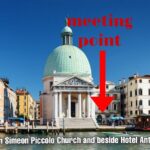
You start at Campo San Giacomo di Rialto (30125 Venezia VE, Italy). You end at Campo San Rocco (30125 Venezia VE, Italy), in front of the Scuola Grande di San Rocco.
Are there tickets or admissions you need to pay for the stops?
Admission is marked as free for the listed stops.
What happens if weather is poor?
The experience requires good weather. If it is canceled due to poor weather, you will be offered a different date or a full refund.
Is there an extra access fee for some visitors?
On certain dates, if you are staying outside Venice and visiting for the day, you may be required to pay a €5 access fee. Details and exemptions are listed here: https://cda.ve.it
Sestieri, Bridge by Bridge
- Venice: Doge’s Palace and St Mark’s Basilica Walking Tour
★ 4.4 · 6,291 reviews - Venice: San Marco to Rialto Walk & Spritz Like a Local
★ 4.2 · 3,651 reviews - Venice Walking Tour and Gondola Ride
★ 3.5 · 3,630 reviews - Venice: City Center Historical Guided Walking Tour
★ 4.2 · 1,873 reviews
Lately added around Venice


Hidden Gems & Backstreet Tours, compared.
Venice Private Gondola Ride: Explore Hidden Canals and Sights
Read our review →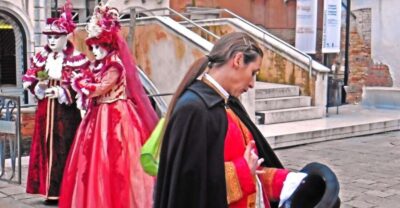
Venice 3,5 hrs tour: Doge’s Palace, St Mark’s and Hidden Gems
Read our review →
Private Secret Venice Tour; Rialto Market, San Polo & Food and Wine tasting
Read our review →Browse the lists this tour appears in